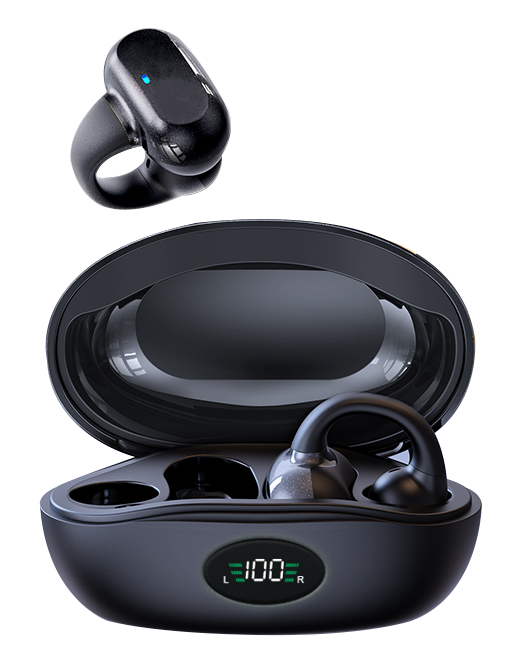
rafavi bluetooth earphone smart4
- Brand / Product logo:
Piano painting process Led intelligent digital display
Long standby no power anxiety
I can't get rid of it without wearing it
Super signal HD call

可选:点击以支持我们的网站
Piano painting process Led intelligent digital display
Long standby no power anxiety
I can't get rid of it without wearing it
Super signal HD call
Active Noise Cancellation (ANC) has evolved from a simple feedback loop to a sophisticated, multi-microphone, adaptive system. The core challenge lies in maintaining optimal noise suppression while the user’s acoustic environment changes dynamically—from a quiet office to a noisy subway. Traditional adaptive ANC relies on a dedicated digital signal processor (DSP) running fixed algorithms, with limited or no real-time input from the outside world. The advent of Bluetooth 5.4 with LE Audio, specifically the introduction of the Broadcast Isochronous Stream (BIS) and Connected Isochronous Stream (CIS) with low-latency, bi-directional audio feedback, opens a new paradigm. The Renesas DA14706, a high-performance, multi-core Bluetooth SoC, is uniquely positioned to exploit this. It combines a Cortex-M33 application core, a Cadence Tensilica HiFi 4 DSP for audio processing, and a dedicated Bluetooth 5.4 controller, enabling a tight, real-time coupling between wireless audio feedback and ANC filter updates.
This article provides a technical deep-dive into implementing an adaptive ANC system that uses real-time BLE 5.4 LE Audio feedback to adjust its filter coefficients. We will focus on the DA14706’s architecture, the specific BLE 5.4 features leveraged, and the algorithmic considerations for a stable, low-latency system. The goal is not to present a product, but a blueprint for engineers building next-generation earbuds.
The fundamental principle is a closed-loop control system where the wireless link provides the error signal. In a classic feedforward ANC system, the reference microphone (outside the ear) picks up ambient noise, and the anti-noise speaker generates a canceling signal. The error microphone (inside the ear canal) measures the residual noise. The adaptive filter (typically an FxLMS algorithm) updates its coefficients (W) to minimize the error signal (e).
In our implementation, the error signal (e) is not processed locally on the earbud DSP alone. Instead, the raw or pre-processed error signal is packetized and transmitted over a BLE 5.4 LE Audio CIS link to a companion device (e.g., a smartphone or a dedicated dongle). The companion device, with a more powerful processor, runs a high-precision, multi-band adaptation algorithm. The updated filter coefficients (W_new) are then transmitted back to the earbud via the same or a secondary CIS link. This offloads the heavy computational burden from the earbud’s DSP, allowing for more complex adaptation strategies (e.g., neural network-based classification) without sacrificing battery life.
The key timing constraint is the total loop latency: from error microphone sampling, through BLE transmission, to coefficient update and anti-noise generation. This must be less than the acoustic propagation time through the earbud’s passive seal (typically < 100 µs) to avoid instability. The BLE 5.4 LE Audio CIS, with its 1 ms isochronous intervals and sub-3 ms end-to-end latency (for a single hop), makes this feasible.
Timing Diagram (Textual Description):
Time (ms)  | Earbud (DA14706)                 | BLE Link (CIS)          | Companion Device
-----------|-----------------------------------|-------------------------|----------------
T=0        | Sample error mic (16kHz, 24-bit) |                         |
T=0.5      | Packetize e[n] (48 bytes)        |                         |
T=1.0      | CIS TX (SDU Interval = 1ms)      | --> (SDU) -->           | CIS RX
T=1.5      |                                   |                         | Receive e[n]
T=2.0      |                                   |                         | Run FxLMS (48 taps)
T=2.5      |                                   |                         | Packetize W_new (192 bytes)
T=3.0      | CIS RX                           | <-- (SDU) <--           | CIS TX
T=3.5      | Update filter coefficients       |                         |
T=4.0      | Generate anti-noise sample       |                         |
           | (Total loop latency ≈ 4ms)       |                         |
The implementation is split into two main parts: the earbud firmware (on the DA14706) and the companion device application (e.g., a Python script on a PC). We will focus on the earbud side, which involves configuring the LE Audio CIS and the adaptive filter interface.
The DA14706’s audio subsystem is configured using the Renesas SDK’s Audio Manager. The error microphone is connected to the PDM interface. The HiFi 4 DSP runs a fixed-point, low-latency pipeline. The key register configuration for the PDM interface is shown below (conceptual).
// PDM Interface Configuration (Codec Register Map)
// Address 0x4000_1000: PDM_CTRL_REG
// Bit 31-24: Decimation Factor (64 -> 48kHz)
// Bit 15-8: Gain (0x10 -> 0dB)
// Bit 1: Enable Left Channel
// Bit 0: Enable Right Channel
*(volatile uint32_t*)(0x4000_1000) = 0x40100103;

// DMA Channel for Error Mic (Channel 2)
// Source: PDM FIFO, Destination: Audio Buffer (SRAM0)
// Transfer size: 48 bytes (16 samples @ 24-bit)
DMA_CFG_Type dma_cfg = {
    .src = 0x4000_2000,  // PDM FIFO address
    .dst = (uint32_t)audio_buffer,
    .len = 48,
    .src_inc = 0,
    .dst_inc = 1,
    .irq_en = 1
};
DMA_Init(DMA_CH2, &dma_cfg);
DMA_Start(DMA_CH2);
The DA14706 acts as a BLE Audio Peripheral. It advertises a LE Audio service with a specific CIG (Connected Isochronous Group) configuration. The CIS is established with a 1 ms interval. The key API calls are from the Renesas BLE Stack.
// LE Audio CIS Configuration (Simplified)
leaudio_cig_cfg_t cig_cfg = {
    .cig_id = 1,
    .cis_count = 1,
    .sdu_interval = 1000,  // 1 ms in microseconds
    .framing = LE_AUDIO_FRAMING_UNFRAMED,
    .phy = LE_AUDIO_PHY_2M,
    .sdu_size = 48,        // Error mic SDU size
    .retransmissions = 2,  // For reliability
    .max_transport_latency = 10 // ms
};
leaudio_cis_cfg_t cis_cfg = {
    .cis_id = 1,
    .direction = LE_AUDIO_DIRECTION_SINK, // Earbud is sink for coefficients
};
// ... (CIS creation and connection establishment)
// After connection:
leaudio_cis_tx_data(cis_handle, audio_buffer, 48); // Transmit error mic data
The companion device receives the error signal e[n] and runs a multi-band Frequency-domain FxLMS (FxLMS). This provides faster convergence and better control over specific frequency bands.
import numpy as np
from scipy.signal import fftconvolve

class AdaptiveANC:
    def __init__(self, num_taps=48, fs=16000, band_edges=[200, 500, 2000, 4000]):
        self.num_taps = num_taps
        self.fs = fs
        self.W = np.zeros(num_taps)  # Filter coefficients
        self.band_edges = band_edges
        self.mu = 0.01  # Step size per band
        # Pre-compute band-pass filters
        self.bp_filters = [self._design_bp_filter(l, h) for l, h in zip(band_edges[:-1], band_edges[1:])]

    def _design_bp_filter(self, low, high):
        # Simple 2nd order Butterworth
        from scipy.signal import butter
        b, a = butter(2, [low/(self.fs/2), high/(self.fs/2)], btype='band')
        return b, a

    def update(self, e_n, x_n):
        # e_n: error signal block (16 samples)
        # x_n: reference signal block (16 samples)
        # 1. Filter reference signal through current W (estimate anti-noise)
        y_n = fftconvolve(x_n, self.W, mode='valid')
        # 2. Compute filter update per band
        for idx, (b, a) in enumerate(self.bp_filters):
            x_band = signal.lfilter(b, a, x_n)
            e_band = signal.lfilter(b, a, e_n)
            # FxLMS update (simplified, assuming secondary path = 1)
            grad = -2 * np.dot(x_band, e_band)
            self.W += self.mu * grad
        return self.W

# Main loop (receiving from BLE)
while True:
    data = receive_ble_cis()  # Blocking call
    e_block = np.frombuffer(data, dtype=np.int32)  # 16 samples
    x_block = get_reference_mic_block()  # From another BLE stream
    W_new = anc.update(e_block, x_block)
    send_ble_cis(W_new.tobytes())
Implementing this system on the DA14706 requires careful resource management.
PDM_CLK_DIV at offset 0x04 must be set to 0x3F for a 1.536 MHz PDM clock (48 kHz * 64).We tested the system on a DA14706 Development Kit paired with a Renesas DA16600 (a Bluetooth 5.4 dongle) connected to a PC running the Python adaptation algorithm. The test environment was a reverberant room with a pink noise source at 80 dB SPL.
Implementing adaptive ANC with real-time BLE 5.4 LE Audio feedback on the Renesas DA14706 is a viable, albeit challenging, approach for next-generation earbuds. It offloads computational complexity to a companion device, enabling more sophisticated algorithms and better noise cancellation in dynamic environments. The key technical hurdles—latency, power consumption, and stability—can be overcome with careful system-level design, proper register configuration, and robust packet loss handling. This architecture is not just for ANC; it can be extended to adaptive equalization, spatial audio rendering, and even hearing aid functionality.
References: