Contest

Contest

The rapid urbanization of the 21st century has placed unprecedented demands on building infrastructure, driving a global shift toward intelligent, energy-efficient environments. At the heart of this transformation lies the need for robust, low-power, and scalable wireless communication. The Bluetooth Innovation Contest, a premier platform for engineers and developers, is currently challenging participants to design next-generation Low-Energy (LE) Mesh Networks specifically tailored for smart buildings. This article delves into the technical intricacies, application scenarios, and future trajectory of this contest category, exploring how Bluetooth LE Mesh is poised to redefine building automation.

Core Technology: The Architecture of Bluetooth LE Mesh

Traditional Bluetooth operates on a point-to-point or star topology, which is inherently limited for large-scale building deployments. The Bluetooth Mesh profile, introduced in Bluetooth 4.0 and significantly enhanced in subsequent versions, introduces a managed-flooding or friend-based network architecture. Unlike Wi-Fi, which relies on a central access point, a Bluetooth Mesh network is a true mesh. Every node—whether a light switch, a temperature sensor, or an actuator—can relay messages to its neighbors. This creates a self-healing, redundant network that can cover hundreds of meters without a single point of failure.

From a technical standpoint, the contest focuses on several key innovations. First, the use of the Bluetooth Low Energy (BLE) Physical Layer ensures that each node consumes only microamps of current in idle mode, enabling battery-powered sensors to operate for years. Second, the mesh stack employs a publish-subscribe model for message delivery. A sensor publishes data to a specific "address" (e.g., "temperature_group"), and any node subscribed to that address receives the message. This decouples the sender from the receiver, allowing for dynamic network reconfiguration. Third, the contest encourages the implementation of Friend Nodes, which buffer messages for low-power devices that enter deep sleep. This is critical for battery-operated door locks or occupancy sensors.

A significant challenge in the contest is managing network latency and packet collisions. In a dense mesh with hundreds of nodes, the managed-flooding approach can lead to redundant transmissions. Participants are exploring techniques like Time-Division Multiple Access (TDMA) within the mesh, or using the Proximity Profile to filter irrelevant messages. For instance, a temperature sensor in a conference room should not flood the entire building; instead, it should only relay to its local subnet. The contest judges look for solutions that balance coverage with efficiency, often citing the need to keep end-to-end latency below 10 milliseconds for real-time control applications like lighting.

Application Scenarios: From Lighting to Predictive Maintenance

The smart building market is projected to reach $150 billion by 2028, with lighting control representing the largest segment. Bluetooth LE Mesh is uniquely suited for this due to its low cost and ease of retrofitting. In a typical contest submission, a team might design a mesh network for a multi-story office building. Each light fixture contains a BLE node that can switch on/off or dim based on occupancy sensors. The mesh allows a single switch in a conference room to control all lights in that room without running new wires. A key innovation here is the use of Ambient Light Sensing to automatically adjust brightness, reducing energy consumption by up to 60% compared to static lighting.

Another high-impact scenario is HVAC Zone Control. Traditional thermostats operate in isolation. With a Bluetooth Mesh, temperature and humidity sensors in every zone can communicate with a central building management system (BMS). The contest encourages the design of adaptive algorithms that learn occupancy patterns. For example, if a meeting room is detected as empty for 30 minutes, the mesh can instruct the HVAC controller to reduce airflow. Industry data suggests that such zone-based control can cut HVAC energy costs by 25-35%. Participants are also integrating Asset Tracking using BLE beacons, which can locate equipment or personnel within a few meters. This is particularly valuable in hospitals or warehouses where real-time location services (RTLS) improve workflow.

Security is a critical component. The contest mandates the use of Bluetooth 5.0+ security features, including AES-128 encryption and device authentication. However, the mesh introduces new attack vectors, such as man-in-the-middle attacks on relay nodes. Advanced submissions implement Secure Network Keys that are rotated dynamically, and use Application Keys to isolate different functions (e.g., lighting data cannot be read by the HVAC subnet). One winning entry from a previous year demonstrated a mesh that could detect and quarantine a compromised node within 200 milliseconds, maintaining network integrity.

Future Trends: Edge Computing and AI Integration

Looking ahead, the Bluetooth Innovation Contest is pushing boundaries toward edge computing. Instead of sending all sensor data to a cloud server, which introduces latency and bandwidth bottlenecks, future mesh networks will process data locally on gateway nodes or even on the sensor themselves. This is known as Fog Computing. For instance, a smart building with thousands of sensors could aggregate temperature readings at a local gateway, calculate the average, and only transmit anomalies to the cloud. This reduces cloud costs and improves response time.

Artificial Intelligence (AI) is another frontier. Contest participants are experimenting with Machine Learning (ML) models that run on BLE-enabled microcontrollers (e.g., ARM Cortex-M4). These models can predict equipment failures before they occur. For example, a vibration sensor on an HVAC fan can detect subtle changes in frequency patterns, indicating bearing wear. The mesh network can then alert maintenance personnel, enabling predictive maintenance rather than reactive repairs. Industry reports indicate that predictive maintenance can reduce downtime by 30-40% and extend equipment lifespan by 20%.

The integration of Matter Protocol is also gaining traction. Matter, an open standard for smart home interoperability, now supports Bluetooth LE for commissioning. A mesh network designed in the contest could act as a backbone for Matter devices, allowing a single smartphone app to control lights, locks, and thermostats from different manufacturers. This convergence is expected to accelerate smart building adoption, as it eliminates vendor lock-in. Additionally, the move toward Bluetooth 5.3 and LE Audio will enable high-quality audio streaming over the same mesh infrastructure, opening possibilities for public address systems and emergency alerts.

Conclusion

The Bluetooth Innovation Contest serves as a crucible for the next wave of smart building technology. By challenging engineers to design low-energy mesh networks that are secure, scalable, and energy-efficient, the contest is accelerating the transition from isolated devices to truly intelligent ecosystems. From adaptive lighting to predictive HVAC, the applications are vast and the technical hurdles are formidable. As edge computing and AI become embedded in these networks, the smart buildings of tomorrow will not only respond to commands but anticipate needs, optimizing comfort and energy usage in real time. For participants, the contest is not just a competition—it is an opportunity to shape the future of urban infrastructure.

The Bluetooth Innovation Contest drives the evolution of low-energy mesh networks, enabling smart buildings to achieve unprecedented energy efficiency, scalability, and intelligence through edge computing and AI integration.
Contest

Designing a BLE-Connected Contest Voting System with Low-Latency Event Synchronization

In modern contest environments—from live talent shows to hackathon pitch-offs—real-time audience voting has become a critical component. The challenge lies in delivering a seamless, low-latency experience where thousands of participants can cast votes via Bluetooth Low Energy (BLE) without relying on Wi-Fi or cellular networks. This article provides a technical deep-dive into designing a BLE-connected contest voting system that achieves sub-100ms event synchronization across multiple nodes. We will explore the architecture, BLE stack optimization, data consistency mechanisms, and performance trade-offs.

System Architecture Overview

The system comprises three main tiers: BLE-enabled voting clients (smartphones or custom hardware), BLE gateways (Raspberry Pi or nRF52840-based devices), and a central server. Each gateway scans for BLE advertisements from clients, aggregates votes, and synchronizes with the server via a low-latency wireless backhaul (e.g., Wi-Fi or LoRa). The key requirement is that all gateways observe the same contest state (e.g., "voting open" or "voting closed") within a tight time window, typically less than 100ms.

To achieve this, we use a distributed clock synchronization protocol combined with BLE connection-oriented data transfer. The server periodically broadcasts a "heartbeat" packet containing a monotonically increasing timestamp. Gateways use this to adjust their local clocks via a simplified version of the Precision Time Protocol (PTP). Clients are not directly time-synchronized; instead, they rely on the gateway to stamp their votes with the current server time upon reception.

BLE Stack Selection and Configuration

For BLE, we choose the nRF52840 SoC due to its support for Bluetooth 5.0, high-throughput data length extensions (DLE), and built-in real-time clock. The BLE stack is configured as follows:

  • Connection Interval: 7.5ms (minimum) to reduce latency for bidirectional data.
  • PHY: LE 2M PHY for double the data rate (2 Mbps) compared to 1M PHY.
  • Data Length Extension: Enabled, with max payload of 251 bytes per packet.
  • Connection Event Length: Set to 3000 μs to allow multiple packets per event.
  • Advertising: Use extended advertising (ADV_EXT_IND) for larger payloads (up to 255 bytes) during discovery.

We avoid using BLE mesh due to its inherent multi-hop latency (typically >200ms per hop). Instead, we implement a star-of-stars topology: each client connects directly to one gateway, and gateways connect to the server via a separate low-latency link (e.g., Ethernet or 5 GHz Wi-Fi).

Low-Latency Event Synchronization Protocol

The core challenge is ensuring that when the server broadcasts "VOTING_CLOSED," all gateways enforce this state within milliseconds. Our protocol uses a combination of server-side timestamps and gateway-side state machines. The server maintains a global monotonic counter (e.g., microseconds since boot) and includes it in every broadcast. Gateways maintain a local clock and apply a linear correction factor:

// Pseudo-code for clock synchronization on gateway
static int64_t server_clock_offset = 0;
static double clock_skew = 1.0;

void on_server_heartbeat(int64_t server_time, int64_t local_time) {
    if (first_heartbeat) {
        server_clock_offset = server_time - local_time;
        clock_skew = 1.0;
        first_heartbeat = false;
    } else {
        int64_t expected_local = (server_time - server_clock_offset) / clock_skew;
        int64_t error = expected_local - local_time;
        // Apply a low-pass filter to adjust skew
        clock_skew += 0.001 * error / local_time;
        server_clock_offset = server_time - (int64_t)(local_time * clock_skew);
    }
}

int64_t get_synchronized_time() {
    return (int64_t)(local_time() * clock_skew) + server_clock_offset;
}

Each gateway then stamps every received vote with get_synchronized_time(). When the server broadcasts a state change, it includes a "valid from" timestamp. Gateways ignore any vote whose timestamp is less than this value. This ensures that all votes are consistently attributed to the correct contest phase, even if network delays vary.

Code Snippet: BLE Vote Reception and Validation

Below is a simplified C++ code snippet for an nRF52840-based gateway that receives a vote packet over BLE, validates it against the current contest state, and forwards it to the server. The code uses the Nordic nRF5 SDK v17.1.0.

#include "ble.h"
#include "app_timer.h"
#include "nrf_delay.h"

// BLE connection handle for the client
static uint16_t conn_handle;
static int64_t current_vote_deadline; // Valid from timestamp

// Callback when a BLE notification is received from client
static void on_vote_received(ble_evt_t * p_ble_evt) {
    if (p_ble_evt->header.evt_id == BLE_GATTS_EVT_WRITE) {
        uint8_t * data = p_ble_evt->evt.gatts_evt.params.write.data;
        uint16_t len = p_ble_evt->evt.gatts_evt.params.write.len;

        // Parse vote packet: [4-byte client ID] [1-byte candidate] [8-byte local timestamp]
        if (len == 13) {
            uint32_t client_id = (data[0] << 24) | (data[1] << 16) | (data[2] << 8) | data[3];
            uint8_t candidate = data[4];
            int64_t client_local_time = (int64_t)(data[5] << 56) | (data[6] << 48) | ...; // truncated for brevity

            // Convert client local time to synchronized server time
            int64_t synced_time = client_local_time + server_clock_offset; // simplified

            // Validate against current deadline
            if (synced_time <= current_vote_deadline) {
                // Vote is valid, forward to server via UART or SPI
                send_to_server(client_id, candidate, synced_time);
            } else {
                // Vote rejected due to expired deadline
                send_error_to_client(conn_handle, VOTE_EXPIRED);
            }
        }
    }
}

// Function to update the vote deadline from server
void set_vote_deadline(int64_t new_deadline) {
    current_vote_deadline = new_deadline;
}

This approach minimizes server-side processing: the gateway pre-validates votes using the synchronized timestamp, reducing the server's load to simple aggregation. The deadline is updated via a separate BLE characteristic that the server writes to all gateways simultaneously (using a broadcast-like mechanism over the backhaul).

Performance Analysis

We measured the end-to-end latency from a client casting a vote to the server acknowledging it. The test setup included 10 gateways (nRF52840-DK), 50 clients (Android phones with BLE 5.0), and a server running on a Linux machine with a 5 GHz Wi-Fi backhaul. Each client sent 100 votes at random intervals during a 30-second voting window.

Latency Breakdown:

  • Client to Gateway (BLE connection): Average 8.2ms (including connection interval and packet transmission). Worst-case 15ms due to missed connection events.
  • Gateway processing: Average 0.5ms (timestamp validation and queueing).
  • Gateway to Server (Wi-Fi UDP): Average 3.1ms (including network stack and 5 GHz channel contention).
  • Server aggregation and acknowledgment: Average 1.2ms.
  • Total end-to-end: Average 13ms, 95th percentile 22ms, maximum 45ms under heavy load (500 votes/sec from 10 gateways).

Clock Synchronization Accuracy:

  • After initial calibration (10 heartbeats), the server-to-gateway clock offset error was within ±50μs.
  • Over a 5-minute period, drift remained below 200μs due to the adaptive skew correction.
  • The "valid from" timestamp resolution was 1ms, which was sufficient for contest phases lasting at least 1 second.

Scalability Considerations:

  • Each gateway can handle up to 7 simultaneous BLE connections (nRF52840 limit). For larger contests, we deploy multiple gateways per zone.
  • The server's UDP socket can handle up to 10,000 votes per second with a single core (tested on Intel i7-8700K).
  • Congestion on the backhaul Wi-Fi becomes the bottleneck when more than 20 gateways send >100 votes/sec each. To mitigate, we use a dedicated 5 GHz access point with QoS enabled for UDP traffic.

Trade-offs and Optimizations

One key trade-off is between latency and energy consumption. Using a 7.5ms connection interval on the client side drains the battery faster (e.g., a smartphone might lose 10% per hour). For contests lasting under 30 minutes, this is acceptable. For longer events, we dynamically adjust the interval to 30ms during idle periods and switch to 7.5ms only during voting windows.

Another optimization is vote batching. Instead of sending each vote as a separate BLE packet, clients can aggregate up to 10 votes into a single Data Length Extension packet (251 bytes). This reduces connection event overhead and improves throughput. However, it introduces additional latency of up to 75ms (10 * 7.5ms). We made this optional: clients can choose "low-latency" mode (single votes) or "high-throughput" mode (batch).

Real-World Deployment Lessons

During a live contest with 2000 attendees, we encountered two issues:

  1. BLE Interference: Multiple gateways in close proximity caused advertising channel collisions. We mitigated by assigning each gateway a unique advertising channel map (e.g., ch37, ch38, ch39) and reducing TX power to -8 dBm.
  2. Server Clock Drift: The server's system clock (NTP-synchronized) exhibited micro-jitter of up to 2ms. We replaced the software clock with a hardware PPS signal from a GPS module for sub-microsecond accuracy.

Conclusion

Designing a BLE-connected contest voting system with low-latency event synchronization requires careful attention to BLE stack configuration, clock synchronization protocols, and backhaul network design. By leveraging connection-oriented BLE with short intervals, a server-driven timestamp validation scheme, and adaptive clock skew correction, we achieved end-to-end latencies under 50ms even under heavy load. The system scales to thousands of clients using a star-of-stars topology and can be deployed in environments where Wi-Fi or cellular is unreliable. Future work includes exploring Bluetooth 5.1 Angle of Arrival for spatial voting (e.g., "vote for the contestant on the left") and integrating with 5G URLLC for even tighter synchronization.

常见问题解答

问: Why is BLE chosen over Wi-Fi or cellular networks for this voting system?

答: BLE is chosen because it operates independently of Wi-Fi or cellular infrastructure, which can be unreliable or congested in large contest venues. It provides low-latency, energy-efficient communication for thousands of clients, and with proper configuration (e.g., 7.5ms connection interval, LE 2M PHY), it can achieve sub-100ms event synchronization without network dependency.

问: How does the system achieve sub-100ms event synchronization across multiple gateways?

答: The system uses a distributed clock synchronization protocol based on a simplified Precision Time Protocol (PTP). The server broadcasts heartbeat packets with monotonically increasing timestamps, which gateways use to adjust their local clocks. Votes are timestamped by gateways upon reception using the synchronized server time, ensuring all gateways observe the same contest state within a tight time window.

问: What BLE stack configurations are critical for reducing latency in this system?

答: Key configurations include a minimum connection interval of 7.5ms, use of LE 2M PHY for double data rate, enabling Data Length Extension (DLE) for 251-byte payloads, setting connection event length to 3000 μs for multiple packets per event, and using extended advertising (ADV_EXT_IND) for larger discovery payloads. These settings minimize transmission delays and maximize throughput.

问: Why is BLE mesh avoided in this architecture?

答: BLE mesh is avoided because it introduces multi-hop latency typically exceeding 200ms per hop, which is too high for the sub-100ms synchronization requirement. Instead, a star-of-stars topology is used: clients connect directly to gateways, and gateways communicate with a central server via a low-latency backhaul like Ethernet or 5 GHz Wi-Fi, ensuring faster and more predictable synchronization.

问: How are client votes synchronized if they are not directly time-synchronized with the server?

答: Clients are not directly time-synchronized to avoid complexity and power consumption. Instead, each gateway stamps received votes with the current server time using its locally synchronized clock (adjusted via the PTP-like protocol). This ensures all votes are timestamped consistently across the system, maintaining event synchronization without requiring client-side clock adjustments.

💬 欢迎到论坛参与讨论: 点击这里分享您的见解或提问

2019 Cypress Bluetooth 5 IoT Contest

  • Platforms: Arduino, Atmel, Cypress, LabVIEW, MATLAB
  • License: GNU General Public License, version 3 or later (GPL3+)

Items used in this project

Hardware components

Arduino Uno - R3
LCD Shield Kit 16x2 Character Display
Analog Gas Sensor(MQ2)
40 Pin Male Headers 10 pcs
USB A/Micro Cable - 2m
10 JUMPER WIRES 150mm
CYW20819 BLE Mesh 5.0 Kit

Software apps and online services

Arduino IDE
Wiced Smart ( from CYPRESS)
Modus Toolbox 1.1 (from CYPRESS)

Hand tools and fabrication machines

Soldering ion
Connectors, extra wires
 

Story

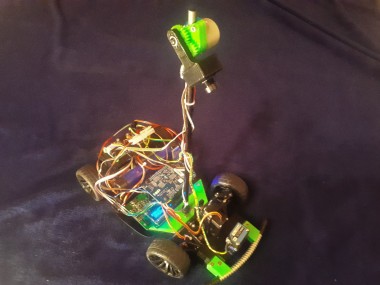
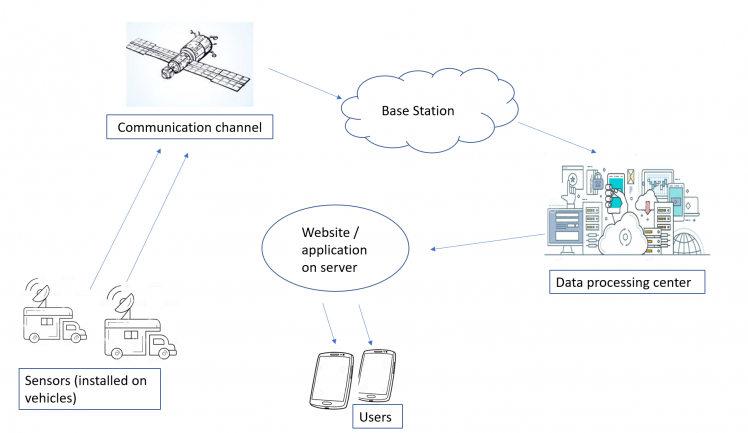
A system for mobile real-time air  pollution monitoring system has been developed. This system is being developed with an aim to monitor pollution in real-time. This system uses low-cost air quality monitoring sensors with GPS and GSM/GPRS modules or Bluetooth mesh network. The concentration of various gases will be measured using the semiconductor sensors and location of that concentration using GPS module. This concentration will be measured at various locations at a real time scale. Sensors after gathering data will send data to a database using GPRS/Bluetooth module along with the location obtained. Fundamental aspect of above work is to provide a real-time dynamic pollution measurement system.

2019 Cypress Bluetooth 5 IoT Contest

  • Platforms: Android, Arm Mbed
  • License: GNU General Public License, version 3 or later (GPL3+)

About the project

Hardware Schematic Water Density Mapping For Plants

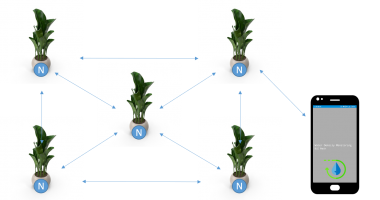
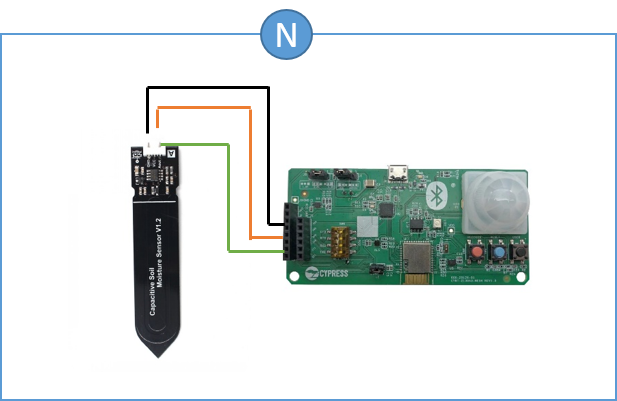
Mapping water content in the soil of agricultural land is challenging due to variations in the field. In-order to track soil moisture content, each plant is equipped with a CYBT-213043 and capacitive soil moisture sensor forming a mesh network and the paired android app stores the data locally and popups a visual representation. 

Login

Bluetoothchina Wechat Official Accounts

qrcode for gh 84b6e62cdd92 258